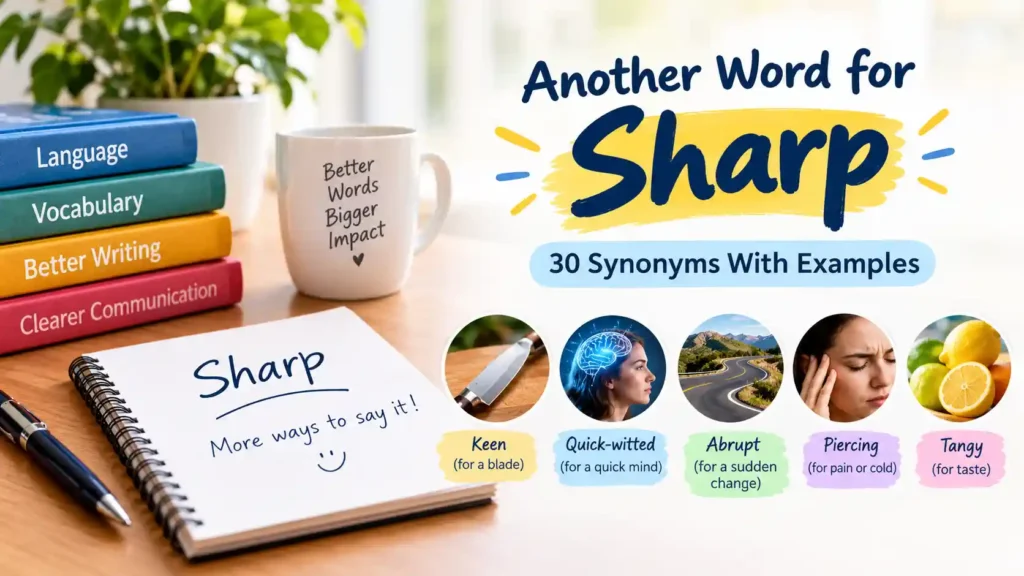
The closest everyday alternatives to “sharp” depend on what is sharp.For a blade, keen or razor-sharp works well. A quick mind can be described as quick-witted, astute, or acute. If you mean a sudden change, choose abrupt or steep. For pain or cold, piercing or biting fits better. When talking about taste, tangy or tart are natural choices.
“Sharp” is a common adjective with many meanings. It can describe a cutting edge, a quick mind, a sudden change, harsh words, a strong taste, a clear image, or even a stylish look. This article covers all of these areas.
Quick list: keen, pointed, razor-sharp, quick-witted, astute, abrupt, piercing, biting, tangy, crisp
Below, you will find 30 alternatives with meanings, IPA, usage notes, examples, and context.
At a Glance: Sharp Synonyms and Related Alternatives
| Alternative | Part of Speech | Meaning | Register / Tone | Ideal Context |
| Keen | Adjective | Having a fine edge; very alert | Neutral to literary | Blades, minds, senses |
| Pointed | Adjective | Having a sharp, tapering end | Neutral | Shapes, tools, objects |
| Razor-sharp | Adjective | Extremely sharp | Neutral, emphatic | Knives, wit, images |
| Quick-witted | Adjective | Able to think and respond fast | Neutral | People, humor |
| Astute | Adjective | Clever and quick to judge a situation | Formal | Business, politics |
| Acute | Adjective | Showing keen insight or sensitivity | Formal to technical | Senses, awareness, pain |
| Abrupt | Adjective | Sudden and unexpected | Neutral | Turns, changes, endings |
| Piercing | Adjective | Sharp enough to seem to cut through | Neutral to literary | Pain, sound, cold |
| Tangy | Adjective | Having a strong, sharp taste | Neutral, positive | Food, sauces |
| Crisp | Adjective | Clear, clean, and sharp in detail | Neutral | Images, edges, air |
Which Word Should You Use?
| If you want to… | Use | Why |
| Describe a knife or blade | razor-sharp, keen | They stress the cutting edge. |
| Describe a quick mind | quick-witted, astute | They fit people who think and judge fast. |
| Describe good eyesight or hearing | acute, keen | They suit the senses. |
| Describe a sudden change | abrupt, steep | They fit turns, drops, and rises. |
| Describe pain or noise that cuts through | piercing, stinging | They name the cutting effect. |
| Describe hurtful words | cutting, biting, scathing | They describe sharp criticism. |
| Describe a strong taste | tangy, tart, pungent | They are the usual food words. |
| Describe a clear image or a stylish look | crisp, smart, dapper | They fit images and dress. |
Exploring the Multiple Meanings of “Sharp”
1. Having a Cutting Edge or a Fine Point
- Meaning: Having a thin edge or fine point that can cut or pierce.
- Explanation: This is the literal sense. Merriam-Webster defines it as “having a thin keen edge or fine point.” It also covers shapes that end in a point, such as “sharp features.”
- Example: Be careful with that sharp knife.
2. Mentally Quick and Alert
- Meaning: Quick in thinking, noticing, and understanding.
- Explanation: Merriam-Webster lists “keen in intellect: quick-witted” and “keen in perception: acute.” The word can describe people, eyes, ears, and minds.
- Example: She has a sharp mind for numbers.
3. Sudden and Marked
- Meaning: Involving an abrupt or very noticeable change, especially in direction.
- Explanation: This sense appears with turns, drops, rises, and contrasts. It stresses both speed and size.
- Example: The road makes a sharp turn to the left.
4. Harsh, Strong, or Painful
- Meaning: Strong and sometimes unpleasant in effect.
- Explanation: Merriam-Webster lists examples such as “sharp pain,” “sharp rebuke,” “sharp temper,” and “sharp cheese.” The common idea is intensity.
- Example: He gave a sharp reply that surprised everyone.
5. Clear and Well-Defined
- Meaning: Having clear edges or details.
- Explanation: This sense describes images, outlines, and contrasts. Merriam-Webster lists “a sharp image.”
- Example: The new screen shows a sharp image.
6. Stylish (Informal)
- Meaning: Neat, smart, and fashionable.
- Explanation: This is an informal use, as in “a sharp dresser.” It describes appearance, not mind or edge.
- Example: He looked sharp in his new suit.
Sources: Merriam-Webster; WordReference (Random House and Collins entries); Etymonline.
Analyzing 30 Sharp Alternatives in Detail
Some of these words are direct synonyms of “sharp,” while others are context-specific related alternatives that fit only one of its meanings, and each Usage note says which is which.
Cutting and Pointed Alternatives
1. Keen
IPA: /kiːn/ (US and UK)
Definition: Having a fine edge; also, very alert or eager.
- Usage: A close synonym. Random House notes that “keen” is usually applied to sharp edges, as in “a keen sword blade.” It also describes a quick, observant mind, and it can mean eager, which is a different sense.
- Example: The knight carried a keen blade.
2. Pointed
IPA: /ˈpɔɪntɪd/ (US and UK)
Definition: Having a sharp, tapering end.
- Usage: A related alternative. It describes shape, not cutting power, so “a pointed knife” is not the same as “a sharp knife.” It also means direct and critical, as in “a pointed remark.”
- Example: The fence posts had pointed tops.
3. Razor-sharp
IPA: US /ˌreɪzər ˈʃɑːrp/ · UK /ˌreɪzə ˈʃɑːp/
Definition: Extremely sharp.
- Usage: A related emphatic alternative. It works for knives and also figuratively, as in “razor-sharp wit.”
- Example: Be careful with that razor-sharp knife.
4. Honed
IPA: US /hoʊnd/ · UK /həʊnd/
Definition: Sharpened with a fine stone; also, perfected through practice.
- Usage: A related alternative. It names the result of sharpening and is common for tools and skills.
- Example: The carpenter worked with a honed chisel.
5. Spiky
IPA: /ˈspaɪki/ (US and UK)
Definition: Having many sharp points.
- Usage: A related informal alternative. It describes shape, as in “spiky hair” and “spiky leaves.”
- Example: The plant has spiky leaves.
Mentally Quick Alternatives
6. Quick-witted
IPA: /ˌkwɪk ˈwɪtɪd/ (US and UK)
Definition: Able to think and respond quickly.
- Usage: A close synonym for the mental sense. Merriam-Webster glosses it as “keen in intellect.”
- Example: Her quick-witted reply made everyone laugh.
7. Astute
IPA: US /əˈstuːt/ · UK /əˈstjuːt/
Definition: Clever and quick to see how to gain an advantage.
- Usage: A related formal alternative. It is common in business and politics.
- Example: He is an astute judge of character.
8. Shrewd
IPA: /ʃruːd/ (US and UK)
Definition: Clever in practical matters; good at judging situations.
- Usage: A related alternative. It can suggest cunning, as in Merriam-Webster’s “sharp trader.”
- Example: She made a shrewd investment.
9. Perceptive
IPA: US /pərˈseptɪv/ · UK /pəˈseptɪv/
Definition: Quick to notice and understand things.
- Usage: A related alternative that stresses noticing, not planning.
- Example: A perceptive teacher saw that the child was struggling.
10. Acute
IPA: /əˈkjuːt/ (US and UK)
Definition: Having or showing keen insight or sensitivity.
- Usage: A close synonym. Merriam-Webster says “sharp, keen, acute” mean “having or showing alert competence and clear understanding.” It also describes severe pain and a small angle, which are different senses.
- Example: He has an acute sense of smell.
Sudden and Marked Alternatives
11. Abrupt
IPA: /əˈbrʌpt/ (US and UK)
Definition: Sudden and unexpected.
- Usage: A close synonym for the “sudden change” sense, as in “an abrupt turn.” It can also mean brusque in speech.
- Example: The road makes an abrupt turn.
12. Sudden
IPA: /ˈsʌdn/ (US and UK)
Definition: Happening quickly and without warning.
- Usage: A related alternative. It stresses timing, while “sharp” suggests both speed and size.
- Example: There was a sudden drop in temperature.
13. Steep
IPA: /stiːp/ (US and UK)
Definition: Rising or falling at a sharp angle; very large, of a change.
- Usage: A related alternative for slopes and changes in price or number.
- Example: The shop saw a steep rise in prices.
14. Marked
IPA: US /mɑːrkt/ · UK /mɑːkt/
Definition: Very noticeable.
- Usage: A related formal alternative. Merriam-Webster pairs “abrupt or marked” in the same definition.
- Example: There was a marked improvement in her grades.
15. Dramatic
IPA: /drəˈmætɪk/ (US and UK)
Definition: Sudden and very large or striking.
- Usage: A related alternative that stresses how big and striking a change is.
- Example: The company saw a dramatic fall in sales.
Harsh and Intense Alternatives
16. Piercing
IPA: US /ˈpɪrsɪŋ/ · UK /ˈpɪəsɪŋ/
Definition: Very sharp or loud in a way that seems to cut through.
- Usage: A close synonym for pain, sound, cold, and looks.
- Example: A piercing scream filled the night.
17. Stinging
IPA: /ˈstɪŋɪŋ/ (US and UK)
Definition: Causing a sharp, burning pain; also, very hurtful, of words.
- Usage: A related alternative for pain and for painful words.
- Example: She delivered a stinging reply.
18. Biting
IPA: /ˈbaɪtɪŋ/ (US and UK)
Definition: Very cold or harsh; sharply critical.
- Usage: A close synonym for a harsh wind or sarcastic words, as in “a biting wind.”
- Example: A biting wind swept across the field.
19. Cutting
IPA: /ˈkʌtɪŋ/ (US and UK)
Definition: Hurtful and unkind, of words.
- Usage: A related alternative for hurtful remarks. It does not describe objects.
- Example: He made a cutting remark about her work.
20. Scathing
IPA: /ˈskeɪðɪŋ/ (US and UK)
Definition: Harshly critical.
- Usage: A related formal alternative. It is stronger than “sharp” and describes criticism.
- Example: The review of the film was scathing.
Taste and Flavor Alternatives
21. Tangy
IPA: /ˈtæŋi/ (US and UK)
Definition: Having a strong, sharp taste or smell.
- Usage: A close synonym for the “sharp cheese” and “sharp sauce” sense. It is neutral and positive.
- Example: The sauce has a tangy flavor.
22. Tart
IPA: US /tɑːrt/ · UK /tɑːt/
Definition: Having a sharp, sour taste; also, sharp and cutting, of words.
- Usage: A related alternative. It is common for fruit and also describes sharp remarks.
- Example: Green apples are tart.
23. Pungent
IPA: /ˈpʌndʒənt/ (US and UK)
Definition: Having a strong, sharp smell or taste.
- Usage: A related alternative. It is used more for smell than taste and can be unpleasant.
- Example: The pungent smell of garlic filled the kitchen.
24. Piquant
IPA: /ˈpiːkənt/ (US and UK)
Definition: Pleasantly sharp or spicy in taste.
- Usage: A related formal and positive alternative.
- Example: The piquant sauce livened up the meal.
25. Zesty
IPA: /ˈzesti/ (US and UK)
Definition: Having a sharp, fresh flavor.
- Usage: A related informal and positive alternative, often used for citrus.
- Example: She made a zesty lemon dressing.
Clear and Stylish Alternatives
26. Crisp
IPA: /krɪsp/ (US and UK)
Definition: Clear, clean, and sharp in detail.
- Usage: A close synonym for the “sharp image” sense. It also describes fresh air and firm food.
- Example: The photo is crisp and full of detail.
27. Distinct
IPA: /dɪˈstɪŋkt/ (US and UK)
Definition: Clearly different or easily seen.
- Usage: A related alternative for outlines and differences.
- Example: The mountains formed a distinct outline against the sky.
28. Smart
IPA: US /smɑːrt/ · UK /smɑːt/
Definition: Neat, stylish, and well-dressed (mainly British).
- Usage: A related alternative for the informal “stylish” sense. It also means intelligent, which is a different sense.
- Example: He wore a smart gray suit.
29. Dapper
IPA: US /ˈdæpər/ · UK /ˈdæpə/
Definition: Neat and stylish, especially in a man’s dress.
- Usage: A related alternative that is formal and old-fashioned.
- Example: The dapper host greeted every guest.
30. Snappy
IPA: /ˈsnæpi/ (US and UK)
Definition: Stylish and fashionable; also, quick and lively.
- Usage: A related informal alternative, as in “a snappy dresser.”
- Example: He is a snappy dresser.
Sources: Merriam-Webster; Collins English Dictionary; Dictionary.com; WordReference (Random House entry).
Sharp vs. Keen vs. Acute: What Is the Difference?
Dictionaries group these words, but they do not feel exactly the same.
| Word | What It Stresses | Typical Use | Example |
| sharp | An alert, penetrating quality, or a cutting edge | Blades and minds | a sharp mind |
| keen | Quickness, enthusiasm, and a penetrating mind; usually used for edges | Blades and observers | a keen observer |
| acute | Alert competence and clear understanding | Senses and awareness | acute hearing |
| quick | Lively, rapid understanding | Learning and response | quick at figures |
| intelligent | Ability to reason and understand | Readers, students | an intelligent reader |
Merriam-Webster says “sharp, keen, acute” mean “having or showing alert competence and clear understanding,” and that keen suggests quickness, enthusiasm, and a penetrating mind. Random House adds that keen is usually applied to sharp edges, while sharp applies to a cutting edge or a piercing point.
Sources: Merriam-Webster; WordReference (Random House entry).
Sharp and Opposite/Paired Word Pairs
| Word | Paired Word | Note |
| sharp | dull | The natural opposite for knives, minds, and pain. |
| sharp | blunt | The opposite for edges and points. |
| sharp | gradual | The opposite for changes, as in “a gradual rise.” |
| sharp | flat | The paired terms in music. |
| sharp | blurry | The opposite for images. |
| sharp | mild | The opposite for taste, as in “mild cheese.” |
“Sharp” has no single opposite. Dull is the most common, but the best choice depends on the sense. Use blunt for edges, gradual for change, mild for taste, and blurry for images.
Sources: Merriam-Webster; Collins English Dictionary.
Common Word Partners of “Sharp”
| Pattern | Common Partners | Example |
| sharp + tool noun | knife, blade, scissors, razor, pencil, point | He sharpened the pencil to a sharp point. |
| sharp + change noun | turn, bend, drop, rise, increase, decline, contrast | There was a sharp drop in temperature. |
| sharp + pain or words | pain, rebuke, criticism, temper, words | She spoke in a sharp voice. |
| sharp + mind or senses | mind, eyes, wit, ears | Her sharp eyes caught the mistake. |
| sharp + food | cheese, taste, flavor, cheddar | The sandwich had a sharp cheddar. |
| time + sharp | three o’clock sharp, 9 a.m. sharp | The meeting starts at nine sharp. |
| sharp + left or right | turn sharp left, bear sharp right | Turn sharp left at the corner. |
Sources: Merriam-Webster; Collins English Dictionary; WordReference (Random House entry).
Idiomatic Phrases Featuring “Sharp”
1. Sharp as a tack
- Meaning: Very intelligent and quick. Etymonline records it from 1912, and the older form “sharp as a needle” goes back to Old English.
- Example: My grandmother is ninety, but she is sharp as a tack.
2. Look sharp
- Meaning: An informal command meaning “hurry up” or “pay attention”; it can also mean “look smart.”
- Example: Look sharp, or you will miss the bus.
3. Sharp practice
- Meaning: Clever but unfair or slightly dishonest dealing, especially in business.
- Example: The firm was accused of sharp practice.
4. A sharp tongue
- Meaning: A habit of speaking in a critical or cutting way.
- Example: He has a sharp tongue, but a kind heart.
Sources: Etymonline; Merriam-Webster; Collins English Dictionary.
Word Formation of “Sharp”
Etymology & Structure
“Sharp” is a short, one-syllable word of Germanic origin. Merriam-Webster traces it to Middle English, from Old English scearp, related to Old High German scarf and perhaps to Old English scrapian, “to scrape.” Etymonline traces it to Proto-Germanic skarpaz, literally “cutting,” from a Proto-Indo-European root meaning “to cut.” Random House notes the cognate German scharf.
Date and History
Dictionary.com places the adjective before the year 900. Etymonline says the Old English word meant “having a cutting edge; pointed; intellectually acute, active, shrewd; keen (of senses); severe; biting, bitter (of tastes).” It dates the music sense to the 1570s and the phrase “sharp as a tack” to 1912.
Word Class Variations
- Adjective: sharp (sharper, sharpest)
- Adverb: sharp (as in “9 a.m. sharp”); sharply
- Noun: sharp (a sharp edge or point; the musical sign ♯; also “card sharp,” a cheat at cards)
- Verb: sharpen (to make sharp); sharp (rare, in music: to raise in pitch)
- Related derivatives: sharpness; sharpener; sharpshooter; razor-sharp; oversharp; unsharp; ultrasharp
Sources: Merriam-Webster; Etymonline; Dictionary.com; WordReference (Random House entry).
Common Word-Choice Mistakes
- The knife is very sharpen: The knife is very sharp.
- He sharped the pencil: He sharpened the pencil.
- There was a sharp raise in prices: There was a sharp rise in prices.
- This cheese tastes sharply: This cheese tastes sharp.
- Meet me at three o’clock sharply: Meet me at three o’clock sharp.
- It is a pointed knife: It is a sharp knife. (Pointed describes shape, not cutting power.)
- He is sharp dresser: He is a sharp dresser.
Frequently Asked Questions
What is the closest synonym for “sharp”?
Keen is the closest for edges and minds. Acute and quick-witted are close for mental sharpness.
What is another word for a very sharp knife?
Razor-sharp and keen are the closest. Honed describes a blade sharpened on a stone.
What is the difference between “sharp” and “keen”?
Keen is usually used for edges and suggests quickness and enthusiasm. Sharp is broader and also covers pain, taste, and sudden change.
What is the difference between “sharp” and “acute”?
Acute stresses alert, clear understanding and is common for senses and awareness. It also describes severe pain and a small angle.
What is a formal alternative to “sharp” for a person?
Astute, perceptive, and acute are formal. Astute suits business, and perceptive suits noticing.
What is another word for sharp taste?
Tangy, tart, pungent, and piquant all work. Tangy is the closest for cheese and sauces.
Can “sharp” describe people?
Yes. It can describe a quick mind, as in “a sharp student,” or an informal stylish look, as in “a sharp dresser.”
What does “sharp” mean in a time, like “9 a.m. sharp”?
It means exactly or promptly at that time. In this use, “sharp” is an adverb.
What does “sharp” mean in music?
It means above the true pitch, or raised by a half step. The sign for a sharp note is ♯, and its pair is “flat.”
What is the opposite of “sharp”?
Dull is the most common opposite. Blunt, gradual, mild, and blurry fit specific senses.
Conclusion
The closest alternatives to “sharp” depend on what is sharp. Keen and razor-sharp fit blades, quick-witted and astute fit minds, abrupt and steep fit sudden changes, piercing and biting fit harsh effects, and tangy fits taste.
Context matters because “sharp” covers many meanings. A word that fits one meaning can fail in another. Pointed describes a shape, scathing describes criticism, and dapper describes dress, not edges.
To choose the right word, first decide what is sharp. Is it a blade, a mind, a change, a pain or remark, a taste, an image, or a style? Then pick the alternative that fits that meaning and your tone.

Sarah Williams is an ESL teacher and content writer with a passion for simplifying English vocabulary. She creates easy-to-understand synonym guides and learning resources that help beginners and intermediate learners build strong language skills.