
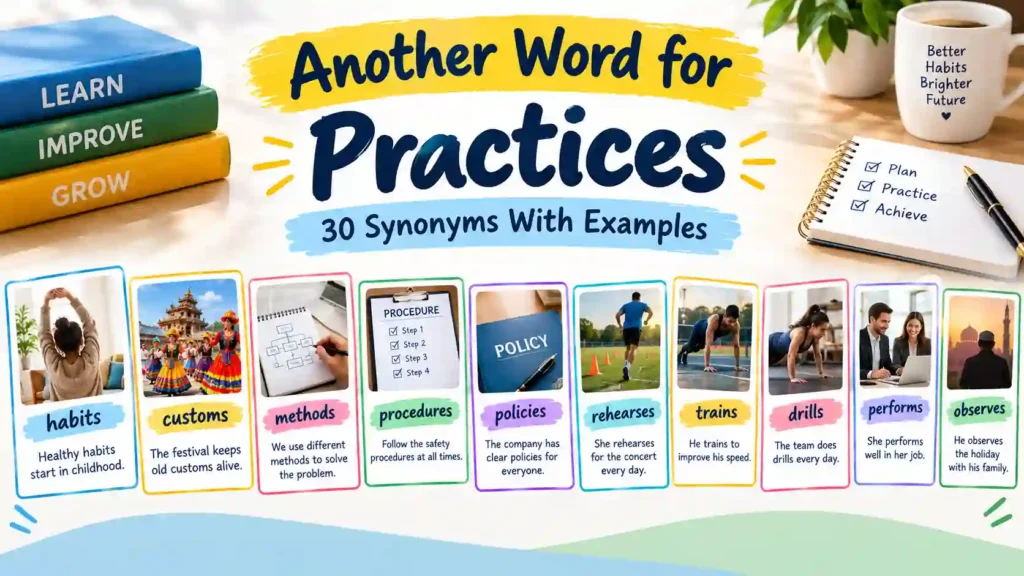
The closest everyday alternatives to “practices” are habits, customs, and methods when you mean the usual ways people do things. When “practices” is a verb, rehearses, trains, and drills fit well for repeated exercise, and performs or carries out fit for doing something. For a professional business, firms and offices are related words, as in a law practice.
The best alternative depends on meaning and context. “Practices” can be a plural noun meaning usual ways of doing things, a plural noun for professional businesses, a plural noun for training sessions, or a verb meaning to repeat something to improve or to do something regularly. A word that suits a company’s rules, such as “procedures,” sounds odd for a piano student, where “rehearses” or “drills” is more natural.
Quick list: habits, customs, methods, procedures, policies, rehearses, trains, drills, performs, observes
This article looks at 30 alternatives to “practices.” Each one has a meaning, IPA pronunciation, usage note, and example sentence, grouped by the sense it fits best.
At a Glance: Practices Synonyms and Related Alternatives
| Alternative | Part of Speech | Meaning | Register / Tone | Ideal Context |
| Habits | Noun | Things done regularly, often without thinking | Neutral, everyday | Personal behavior |
| Customs | Noun | Traditional ways of doing things | Neutral | Culture, society |
| Methods | Noun | Planned ways of doing something | Neutral to formal | Work, science, teaching |
| Procedures | Noun | Fixed steps for doing a task | Formal | Offices, hospitals, law |
| Policies | Noun | Official rules or plans of action | Formal | Government, business |
| Rehearses | Verb | Repeats something to prepare for a performance | Neutral | Music, theater, speeches |
| Trains | Verb | Practices a skill to get better | Neutral | Sport, work skills |
| Drills | Verb | Repeats something many times to learn it | Neutral | Sport, language, military |
| Performs | Verb | Does or carries out an action | Neutral to formal | Duties, tasks |
| Observes | Verb | Follows a rule, custom, or holiday | Formal | Religion, law, holidays |
Which Word Should You Use?
| If you want to… | Use | Why |
| Describe things people do regularly | Habits, routines | Both suggest repeated behavior |
| Describe traditional ways in a culture | Customs, traditions | Both suggest long-standing ways |
| Describe planned ways of working | Methods, techniques | Both suggest a chosen way of doing something |
| Describe official steps in a workplace | Procedures, protocols | Both suggest fixed, formal steps |
| Say someone repeats a skill to improve | Rehearses, drills | Both show repeated effort |
| Say someone follows a religious rule | Observes, keeps | Both suit rules and holidays |
| Name a doctor’s or lawyer’s business | Firm, office | They name the working organization |
| Say someone does something regularly as a job | Performs, carries out | Both describe doing a task |
Exploring the Multiple Meanings of “Practices”
1. Usual Ways of Doing Things (Noun)
- Meaning: Actions or ways of doing things that people do regularly or by custom.
- Explanation: This is the most common noun sense. It describes behavior in a group, a company, or a culture, and it can be good or bad.
- Example: The company has been criticized for unfair hiring practices.
2. Professional Businesses (Noun)
- Meaning: The work or business of a doctor, lawyer, or similar professional.
- Explanation: This sense is used for professional offices, as in “a medical practice.” It can also describe the work itself.
- Example: Two doctors opened a small practice in the town.
3. Training Sessions (Noun)
- Meaning: Times set aside to repeat an activity in order to improve.
- Explanation: In school and sport, “practices” often names regular training sessions. It is common in American English for sports teams.
- Example: The team has two practices every week.
4. To Repeat in Order to Improve (Verb)
- Meaning: To do something again and again to get better at it.
- Explanation: As a verb, “practices” is third-person singular. It shows that a person trains in a skill.
- Example: She practices the piano every evening.
5. To Do Something Regularly or Follow It (Verb)
- Meaning: To do something as a habit, or to follow a belief or profession.
- Explanation: This sense covers religion, professions, and ways of living.
- Example: He practices law in Chicago.
Sources: Merriam-Webster; Collins English Dictionary; Dictionary.com.
Analyzing 30 Practices Alternatives in Detail
Some of these words are direct synonyms of “practices,” while others fit only one sense, so each usage note says which is which.
Habits and Customs
1. Habits
IPA: /ˈhæbɪts/ (US and UK)
Definition: Things a person does regularly, often without thinking.
- Usage: A close synonym for the “usual ways” sense when talking about people. It is neutral and everyday.
- Example: Healthy habits start in childhood.
2. Customs
IPA: /ˈkʌstəmz/ (US and UK)
Definition: Traditional ways of behaving in a group or society.
- Usage: A direct synonym for the cultural sense. It stresses tradition more than “practices” does.
- Example: The festival keeps old customs alive.
3. Traditions
IPA: /trəˈdɪʃənz/ (US and UK)
Definition: Beliefs or ways of acting passed down over time.
- Usage: A related alternative. It stresses age and passing down, so it is narrower than “practices.”
- Example: Family traditions bring us together at the holidays.
4. Routines
IPA: /ruːˈtiːnz/ (US and UK)
Definition: Regular sets of actions done in the same order.
- Usage: A related alternative. It suggests a fixed daily order, not a general way of behaving.
- Example: Her morning routines save her time.
5. Conventions
IPA: /kənˈvɛnʃənz/ (US and UK)
Definition: Accepted ways of doing things within a group.
- Usage: A related, formal alternative. It suggests agreed rules, often unwritten.
- Example: The writer followed the conventions of formal letters.
6. Rituals
IPA: /ˈrɪtʃuəlz/ (US and UK)
Definition: Fixed sets of actions done in a set way, often with meaning.
- Usage: A related alternative. It suggests ceremony or deep meaning, so it is not a general synonym.
- Example: The family has simple rituals for the new year.
Methods and Procedures
7. Methods
IPA: /ˈmɛθədz/ (US and UK)
Definition: Planned ways of doing something.
- Usage: A close synonym for the “ways of working” sense. It is neutral to formal.
- Example: The school uses modern teaching methods.
8. Procedures
IPA: /prəˈsiːdʒərz/ (US and UK)
Definition: Fixed steps for doing a task.
- Usage: A close, formal synonym for workplace practices. It suggests an official order of steps.
- Example: Hospital procedures protect patients.
9. Techniques
IPA: /tɛkˈniːks/ (US and UK)
Definition: Special ways of doing a skilled task.
- Usage: A related alternative. It points to skill and craft.
- Example: The artist learned new painting techniques.
10. Approaches
IPA: US /əˈproʊtʃɪz/ · UK /əˈprəʊtʃɪz/
Definition: Ways of thinking about or dealing with something.
- Usage: A related alternative. It focuses on general style of handling a matter.
- Example: The two teams have different approaches to the problem.
11. Protocols
IPA: US /ˈproʊtəkɔːlz/ · UK /ˈprəʊtəkɒlz/
Definition: Official systems of rules for how to act.
- Usage: A formal, related alternative. It suits medicine, diplomacy, and computing.
- Example: The nurses follow strict safety protocols.
Rules and Policies
12. Policies
IPA: /ˈpɒləsiz/ UK · /ˈpɑːləsiz/ US
Definition: Official plans or rules that guide decisions.
- Usage: A related, formal alternative. It names official rules, while “practices” can name what people actually do.
- Example: The company’s policies on leave are clear.
13. Standards
IPA: US /ˈstændərdz/ · UK /ˈstændədz/
Definition: Levels of quality or rules that people are expected to meet.
- Usage: A related alternative. It describes the level expected, not the action itself.
- Example: The factory meets high safety standards.
14. Norms
IPA: US /nɔːrmz/ · UK /nɔːmz/
Definition: Usual or accepted ways of behaving in a group.
- Usage: A related alternative. It is common in social science and describes what is expected of people.
- Example: Social norms differ from country to country.
15. Rules
IPA: /ruːlz/ (US and UK)
Definition: Statements telling people what they may or must do.
- Usage: A related alternative. Rules say what should happen, while practices describe what does happen.
- Example: The club has simple rules for members.
Professional Businesses
16. Firms
IPA: US /fɜːrmz/ · UK /fɜːmz/
Definition: Businesses, especially those run by professionals.
- Usage: A related alternative for the “professional business” sense only. It is common for law and accounting.
- Example: Several law firms are hiring.
17. Offices
IPA: US /ˈɔːfɪsɪz/ · UK /ˈɒfɪsɪz/
Definition: Places where professionals work and see clients.
- Usage: A related alternative. It names the place, not the business as a whole.
- Example: The doctor has offices in two towns.
18. Clinics
IPA: /ˈklɪnɪks/ (US and UK)
Definition: Places where people receive medical advice or treatment.
- Usage: A related alternative for the medical sense. It does not fit law or accounting.
- Example: The town has three dental clinics.
19. Businesses
IPA: /ˈbɪznəsɪz/ (US and UK)
Definition: Organizations that sell goods or services.
- Usage: A related, general alternative. It is neutral and does not suggest a profession.
- Example: Small businesses support the local economy.
Training and Repeating
20. Rehearses
IPA: US /rɪˈhɜːrsɪz/ · UK /rɪˈhɜːsɪz/
Definition: Repeats something to prepare for a performance.
- Usage: A close synonym for the verb sense in music, theater, and speaking.
- Example: She rehearses her speech every night.
21. Trains
IPA: /treɪnz/ (US and UK)
Definition: Practices a skill or sport to improve.
- Usage: A close synonym for the verb sense. It is common in sport and work skills.
- Example: He trains at the gym three times a week.
22. Drills
IPA: /drɪlz/ (US and UK)
Definition: Repeats something many times to learn it well.
- Usage: A related alternative. It suggests firm, repeated exercise.
- Example: The teacher drills new words with the class.
23. Rehearsals
IPA: US /rɪˈhɜːrsəlz/ · UK /rɪˈhɜːsəlz/
Definition: Practice sessions before a performance.
- Usage: A related alternative for the noun sense. It is used for events such as plays and concerts.
- Example: The band has two rehearsals this week.
24. Exercises
IPA: US /ˈɛksərsaɪzɪz/ · UK /ˈɛksəsaɪzɪz/
Definition: Activities done to improve a skill or the body.
- Usage: A related alternative. It names a task for improving a skill and works as a noun or verb.
- Example: The book has exercises after each chapter.
25. Studies
IPA: /ˈstʌdiz/ (US and UK)
Definition: Learns about a subject by reading and thinking.
- Usage: A related alternative. It stresses learning and not repeated physical training.
- Example: She studies French on the bus.
Doing and Following
26. Performs
IPA: US /pərˈfɔːrmz/ · UK /pəˈfɔːmz/
Definition: Does or carries out an action or duty.
- Usage: A related alternative for the “do something regularly” sense. It is neutral to formal.
- Example: The surgeon performs several operations daily.
27. Carries out
IPA: US /ˈkæriz aʊt/ · UK /ˈkæriz aʊt/
Definition: Does a task or plan fully.
- Usage: A related alternative. It suggests completing a job rather than repeating it to improve.
- Example: The team carries out safety checks every morning.
28. Observes
IPA: US /əbˈzɜːrvz/ · UK /əbˈzɜːvz/
Definition: Follows a law, rule, custom, or holiday.
- Usage: A formal, related alternative. It fits rules, holidays, and religious customs.
- Example: The town observes a day of silence each year.
29. Follows
IPA: US /ˈfɑːloʊz/ · UK /ˈfɒləʊz/
Definition: Acts according to a rule, belief, or way of life.
- Usage: A related alternative. It is simple and works for rules and beliefs.
- Example: She follows a simple diet.
30. Applies
IPA: /əˈplaɪz/ (US and UK)
Definition: Uses a method, rule, or idea in a real situation.
- Usage: A related alternative. It stresses using knowledge in action.
- Example: The nurse applies what she learned in class.
Sources: Merriam-Webster; Collins English Dictionary and Collins Thesaurus; Dictionary.com; Oxford Learner’s Dictionaries (pronunciation).
Practice vs. Practise vs. Practices: Spelling and Grammar
| Form | Part of Speech | Where Used | Example |
| Practice | Noun (US and UK); verb (US) | Everywhere | She goes to piano practice. |
| Practise | Verb (UK, mainly) | British spelling of the verb | She practises the piano. |
| Practices | Plural noun; verb (US) | Everywhere | The practices are listed below. |
| Practises | Verb (UK, mainly) | British third-person verb | He practises every day. |
American English uses “practice” for both noun and verb. British English usually uses “practice” for the noun and “practise” for the verb. “Practices” is a plural noun in both, and the verb form depends on the spelling system.
Sources: Merriam-Webster; Collins English Dictionary; Cambridge Dictionary.
Practices and Opposite/Paired Word Pairs
| Word | Paired Word | Note |
| Practices | Theory | A common pair: what is done versus what is believed |
| Practices | Policies | Actual behavior versus official rules |
| Practices | Principles | Actions versus basic beliefs |
| Practices | Performance | Training versus the real event |
| Practices | Ideals | What people do versus what they hope to do |
| Practices | Preaching | Used in the saying about acting, not just speaking |
“Practices” has no single opposite. Its natural pairs are “theory” and “principles,” which describe ideas, and “performance,” which describes the real event after training.
Sources: Merriam-Webster; Collins English Dictionary and Collins Thesaurus.
Common Word Partners of “Practices”
| Pattern | Common Partners | Example |
| adjective + practices | business, common, unfair, standard, best, traditional | The company follows best practices. |
| practices + of | practices of the company, practices of the past | The practices of the past were different. |
| noun + practices | hiring practices, farming practices, religious practices | Farming practices have changed. |
| verb + practices | follow, adopt, ban, change, review | The city banned harmful practices. |
| practices + verb | vary, differ, change | Practices vary from school to school. |
| medical / dental / legal practices | medical practices, dental practices, law practices | Several medical practices share the building. |
Sources: Collins English Dictionary; Oxford Collocations Dictionary; Merriam-Webster.
Idiomatic Phrases Featuring “Practices”
“Practices” has few true idioms. The items below are established expressions that use “practice,” and they are treated as expressions, not idioms.
1. Best practices
- Meaning: Methods that are accepted as the most effective way of doing something.
- Example: The training covers best practices in customer service.
2. Put into practice
- Meaning: To begin to use an idea or plan in real life.
- Example: She put the new method into practice at once.
3. Practice makes perfect
- Meaning: Repeating something many times leads to skill.
- Example: Keep going, because practice makes perfect.
4. Out of practice
- Meaning: Not as good at a skill because you have not done it recently.
- Example: I am out of practice, so my tennis is poor.
Sources: Merriam-Webster; Collins English Dictionary; Cambridge Dictionary.
Word Formation of “Practices”
Etymology & Structure
“Practices” is the plural of the noun “practice” and the third-person singular of the verb “practice.” The word comes from Old French and Latin roots connected to Greek praktikos, meaning “practical” or “fit for action.” The ending “-s” shows plural or third-person singular.
Date and History
The word has been in English since the Middle Ages, and the noun and verb spellings later became different in British English. Dictionaries give different dates by sense, so check Etymonline or the Oxford English Dictionary for exact years.
Word Class Variations
- Noun: practice, practices
- Verb: practice (practices, practiced, practicing); British: practise (practises, practised, practising)
- Adjective: practical, practiced (skilled), practicing (a practicing doctor)
- Adverb: practically
- Related nouns: practitioner, practicality
Sources: Etymonline; Merriam-Webster; Collins English Dictionary.
Common Word-Choice Mistakes
- She practices to be a doctor: she is training to be a doctor. “Practice” is not used for studying a career in this way.
- He practices the law: he practices law. Do not add “the” before “law.”
- The team has three practice every week: the team has three practices every week. Use the plural after “three.”
- I practised the exam: I took the exam, or I practiced for the exam. “Practice” means preparing, not doing the real event.
- Good practices is important: good practices are important. Use the plural verb.
- A practiced doctor means a lawyer: a practicing doctor is currently working, while a practiced doctor is skilled.
- The firm has bad practices of tea: the firm has bad practices in hiring. Name the area of work.
Frequently Asked Questions
What is the closest synonym for practices?
“Habits,” “customs,” and “methods” are the closest, depending on the sense. “Procedures” fits formal workplace use.
What is another word for business practices?
“Procedures,” “policies,” “methods,” and “protocols” are common choices.
What is another word for practices as a verb?
“Rehearses,” “trains,” “drills,” and “performs” fit different senses.
What is another word for medical practices?
“Clinics,” “offices,” and “surgeries” are natural, with “surgeries” used in British English.
What is another word for sports practices?
“Training sessions,” “drills,” “workouts,” and “rehearsals” are common.
What is the difference between practices and habits?
“Habits” are things a person does regularly, often without thinking. “Practices” can also describe group or business behavior.
What is the difference between practices and policies?
“Policies” are official rules. “Practices” are what people actually do, which may be different.
What is a formal alternative to practices?
“Procedures,” “protocols,” and “conventions” are formal.
Is practices a noun or a verb?
Both. It is the plural of the noun “practice” and the third-person form of the verb “practice” in American English.
What is the opposite of practices?
There is no single opposite. “Theory” and “principles” are natural contrasts.
Conclusion
The closest everyday alternatives to “practices” are “habits,” “customs,” and “methods” for ways of doing things. For work, “procedures” and “policies” are common, and for training, “rehearses,” “trains,” and “drills” fit well.
Context decides which word works. Some alternatives describe behavior, some describe official rules, some name professional businesses, and some describe repeated training, so a good synonym in one sentence can be wrong in another.
To choose well, first decide which meaning of “practices” you want. Then pick the word that matches that meaning and the tone of your writing, formal or casual.

Sarah Williams is an ESL teacher and content writer with a passion for simplifying English vocabulary. She creates easy-to-understand synonym guides and learning resources that help beginners and intermediate learners build strong language skills.