
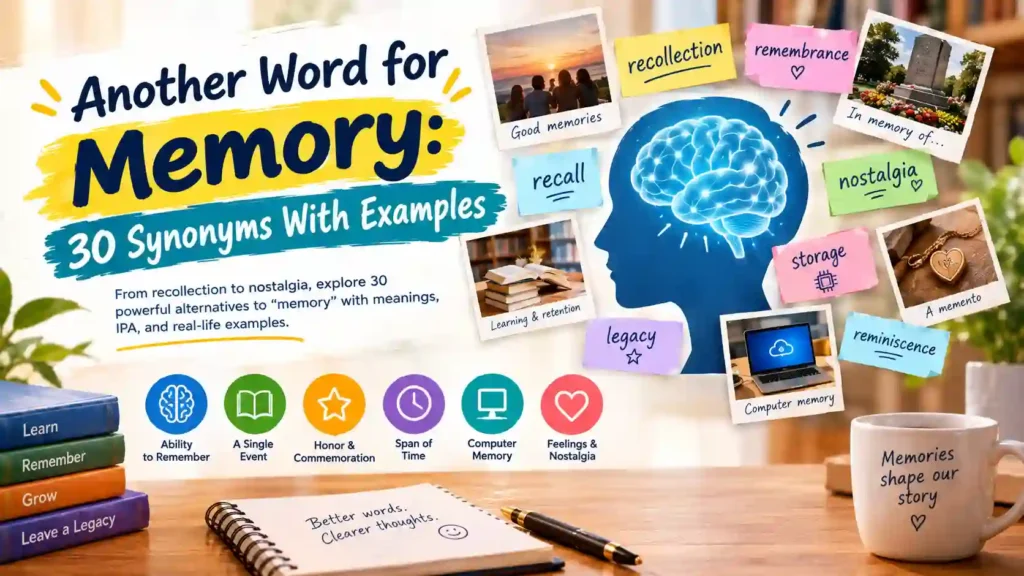
The closest everyday alternatives to “memory” are recollection and remembrance when you mean something you remember, and recall when you mean the ability to remember. The best choice depends on which meaning you need.
“Memory” has several uses. It can be the mind’s ability to remember, a single remembered event, an act of honor (“in memory of”), the span of time people remember, or the storage in a computer. This article covers all of these areas.
Quick list: recall, recollection, remembrance, reminiscence, retention, commemoration, memento, legacy, storage, nostalgia
Below, you will find 30 alternatives with meanings, IPA, usage notes, examples, and context.
At a Glance: Memory Synonyms and Related Alternatives
| Alternative | Part of Speech | Meaning | Register / Tone | Ideal Context |
| Recall | Noun | The ability to remember something | Neutral to technical | Tests, psychology, everyday talk |
| Retention | Noun | The ability to keep information in mind | Neutral to formal | Learning, education |
| Recollection | Noun | Something remembered, or the act of remembering | Neutral to formal | Past events, statements |
| Remembrance | Noun | A memory, or the act of remembering to honor | Formal | Ceremonies, tributes |
| Reminiscence | Noun | A story or memory about the past | Neutral to literary | Conversations, books |
| Flashback | Noun | A sudden, vivid memory | Neutral | Stories, trauma, films |
| Commemoration | Noun | An act that honors a person or event | Formal | Ceremonies, anniversaries |
| Memento | Noun | An object kept as a reminder | Neutral | Travel, gifts, loss |
| Legacy | Noun | What lasts after a person is gone | Neutral to formal | Careers, families, history |
| Storage | Noun | The space or device that keeps data | Neutral, technical | Phones, computers |
Which Word Should You Use?
| If you want to… | Use | Why |
| Say you can hold information in your mind | recall, retention | They name the ability, not a single event. |
| Describe one thing you remember | recollection, reminiscence | They name a remembered thing or story. |
| Describe a sudden, vivid memory | flashback | It suggests the memory returns suddenly. |
| Honor a person who has died | commemoration, tribute, memorial | They name the act or object of honor. |
| Name an object that keeps a memory alive | memento, souvenir | They name a thing, not the memory itself. |
| Describe fame that lasts after death | legacy, renown | They stress what remains in people’s minds. |
| Describe a computer’s memory | storage, RAM | They are the usual technical words. |
| Describe a longing for the past | nostalgia | It names the feeling that memories bring. |
Exploring the Multiple Meanings of “Memory”
1. The Ability to Remember
- Meaning: The power of the mind to keep and recall information and experiences.
- Explanation: This is the central sense. It describes a skill a person has, as in “a good memory.” Etymonline dates this sense to the late 14th century.
- Example: He has a good memory for names.
2. Something Remembered
- Meaning: A person, event, or feeling that is remembered.
- Explanation: In this sense the word is countable, as in “a happy memory” or “childhood memories.” It names the thing remembered, not the ability.
- Example: Her first day of school is a happy memory.
3. Honor and Commemoration
- Meaning: The act of remembering a person or event in order to honor them.
- Explanation: This sense appears in the fixed phrase “in memory of.” Etymonline dates the sense “commemoration” to about 1300.
- Example: The statue was built in memory of the town’s founder.
4. The Span of Time That Is Remembered
- Meaning: The period of time that people can remember.
- Explanation: This sense appears in phrases like “in living memory” and “in recent memory.” Etymonline dates it to the 1520s.
- Example: It was the worst flood in living memory.
5. Computer Memory
- Meaning: A device or component in which a computer stores information.
- Explanation: Etymonline dates this sense to 1946. In everyday use it often means RAM, the memory used for programs that are running now.
- Example: The laptop has 16 gigabytes of memory.
6. A Material’s Ability to Return to Its Shape
- Meaning: The ability of certain materials to return to their original shape after being pressed or bent.
- Explanation: This sense appears in “memory foam” and “memory metal.” It is a specialist use.
- Example: The pillow is made of memory foam.
Sources: Merriam-Webster; Etymonline; WordReference (Collins and Random House entries); Wiktionary.
Analyzing 30 Memory Alternatives in Detail
Some of these words are direct synonyms of “memory,” while others are context-specific related alternatives that fit only one of its meanings, and each Usage note says which is which.
Ability to Remember
1. Recall
IPA: /ˈriːkɔːl/ (US and UK)
Definition: The ability to remember something; the act of remembering.
- Usage: A direct synonym for the “ability” sense, as in “total recall.” It is neutral to technical. As a noun it also means an official order to return a faulty product, which is a different meaning.
- Example: She has remarkable recall for dates.
2. Retention
IPA: /rɪˈtenʃən/ (US and UK)
Definition: The ability to keep information in the mind.
- Usage: A related alternative. It focuses on holding what has been learned and is common in education.
- Example: Short videos can improve retention of new words.
3. Retentiveness
IPA: /rɪˈtentɪvnəs/ (US and UK)
Definition: The power of keeping things in memory.
- Usage: A related formal alternative. It is rare in everyday speech.
- Example: Her retentiveness surprised her teachers.
4. Mind
IPA: /maɪnd/ (US and UK)
Definition: In older use, memory or recollection.
- Usage: A related alternative that survives mainly in set phrases like “bear in mind” and “call to mind.” Merriam-Webster records it as a sense of “mind.”
- Example: Call to mind what the teacher said yesterday.
5. Memorization
IPA: /ˌmeməraɪˈzeɪʃən/ (US and UK)
Definition: The act of learning something so you can remember it exactly.
- Usage: A related alternative. It names the process of learning by heart, not the ability itself.
- Example: The test required memorization of a long list.
Something Remembered
6. Recollection
IPA: /ˌrekəˈlekʃən/ (US and UK)
Definition: The act of remembering; something remembered.
- Usage: A close synonym for the “something remembered” sense. It is neutral to formal and often suggests an effort to remember.
- Example: I have no recollection of that meeting.
7. Remembrance
IPA: /rɪˈmembrəns/ (US and UK)
Definition: A memory; the act of remembering, especially to honor someone.
- Usage: A direct synonym that is more formal than “memory.” It often appears in ceremonies, as in “day of remembrance.”
- Example: The statue stands in remembrance of those who died.
8. Reminiscence
IPA: /ˌremɪˈnɪsns/ (US and UK)
Definition: A story or memory about the past, often a pleasant one.
- Usage: A related alternative. It is often plural and describes the telling of memories more than the memory itself.
- Example: He filled the evening with reminiscences of his school days.
9. Flashback
IPA: /ˈflæʃbæk/ (US and UK)
Definition: A sudden, vivid memory of a past event.
- Usage: A related alternative. It stresses a memory that returns suddenly. It also names a scene in a film or book that shows the past.
- Example: The smell of smoke caused a flashback to the fire.
10. Impression
IPA: /ɪmˈpreʃən/ (US and UK)
Definition: An idea or feeling about someone or something, formed from limited experience.
- Usage: A related alternative for a faint or partial memory, as in “a faint impression.” It is less exact than “recollection.”
- Example: I have only a faint impression of the house.
Commemoration and Keepsakes
11. Commemoration
IPA: /kəˌmeməˈreɪʃən/ (US and UK)
Definition: An act or ceremony that honors the memory of a person or event.
- Usage: A direct synonym for the “in memory of” sense. It is formal and shares its root with “memory.”
- Example: The concert was held in commemoration of the town’s founding.
12. Tribute
IPA: /ˈtrɪbjuːt/ (US and UK)
Definition: Something said or done to show respect or admiration.
- Usage: A related alternative. It honors a person but does not mean the memory itself.
- Example: Fans left flowers as a tribute to the singer.
13. Memorial
IPA: US /məˈmɔːriəl/ · UK /məˈmɔːriəl/
Definition: Something built or held to keep alive the memory of a person or event.
- Usage: A related alternative. It names the object or event, not the mental ability.
- Example: A memorial stands in the park.
14. Memento
IPA: US /məˈmentoʊ/ · UK /məˈmentəʊ/
Definition: An object kept as a reminder of a person or event.
- Usage: A related alternative. It names a thing, not the memory itself.
- Example: She kept a shell as a memento of the trip.
15. Souvenir
IPA: US /ˌsuːvəˈnɪr/ · UK /ˌsuːvəˈnɪə/
Definition: An object bought or kept as a reminder of a place or event.
- Usage: A related alternative with a limit. In English it names an object, usually from a trip, and does not mean a memory.
- Example: He bought a small statue as a souvenir.
Fame, Legacy, and Records
16. Legacy
IPA: /ˈleɡəsi/ (US and UK)
Definition: Something handed down from the past, such as influence or reputation.
- Usage: A related alternative. It names what lasts after a person is gone.
- Example: The teacher’s legacy lives on in her students.
17. Renown
IPA: /rɪˈnaʊn/ (US and UK)
Definition: Widespread fame and respect.
- Usage: A related formal alternative. Etymonline records that “memory” once meant “fame, renown” in the late 13th century.
- Example: The chef is a person of great renown.
18. Fame
IPA: /feɪm/ (US and UK)
Definition: The state of being widely known.
- Usage: A related alternative. It reflects an old sense of “memory,” as in “a ruler of beloved memory.”
- Example: The poet’s fame outlasted her life.
19. Reputation
IPA: /ˌrepjuˈteɪʃən/ (US and UK)
Definition: What people generally think of someone or something.
- Usage: A related alternative. It names a general opinion, not a single memory.
- Example: The firm has a reputation for quality.
20. Record
IPA: US /ˈrekərd/ · UK /ˈrekɔːd/
Definition: A written account that preserves information about the past.
- Usage: A related alternative. Etymonline notes that the Old French word for “memory” also meant “record.” A record is written, not mental.
- Example: The museum keeps a record of every donation.
Computer Memory and Storage
21. Storage
IPA: /ˈstɔːrɪdʒ/ (US and UK)
Definition: The space or process for keeping data.
- Usage: A related alternative for the computing sense. Collins and Random House list it as another name for computer memory, but technical writers often use “memory” for fast, short-term use and “storage” for files kept long term.
- Example: The phone has 128 gigabytes of storage.
22. RAM
IPA: /ræm/ (US and UK)
Definition: Random-access memory; the computer memory used for programs that are running now.
- Usage: A related alternative. It is a type of memory, not every kind. It is the word most people mean when they say a computer “needs more memory.”
- Example: Close some apps to free up RAM.
23. Cache
IPA: /kæʃ/ (US and UK)
Definition: A small store of data kept for quick access.
- Usage: A related technical alternative. It describes one kind of fast memory.
- Example: Clearing the cache can fix the page.
24. Buffer
IPA: US /ˈbʌfər/ · UK /ˈbʌfə/
Definition: A temporary memory area that holds data while it is moved.
- Usage: A related technical alternative. It describes short-term holding, not general memory.
- Example: The video paused while the buffer filled.
25. Capacity
IPA: /kəˈpæsəti/ (US and UK)
Definition: The amount that something can hold.
- Usage: A related alternative. It tells how much memory a device has, as in “memory capacity.”
- Example: The device has a capacity of 64 gigabytes.
Feeling, Echoes, and Memory Aids
26. Nostalgia
IPA: US /nɑːˈstældʒə/ · UK /nɒˈstældʒə/
Definition: A sentimental longing for the past.
- Usage: A related alternative. It names the feeling that memories bring, not the memory.
- Example: The old song filled her with nostalgia.
27. Retrospection
IPA: /ˌretrəˈspekʃən/ (US and UK)
Definition: The act of looking back at past events.
- Usage: A related formal alternative. It describes the act of thinking back, not the stored memory.
- Example: In retrospection, the plan seemed risky.
28. Echo
IPA: US /ˈekoʊ/ · UK /ˈekəʊ/
Definition: In figurative use, a faint reminder of something from the past.
- Usage: A related figurative alternative, as in “echoes of the past.” It is used for faint or lingering traces.
- Example: The house held echoes of her childhood.
29. Trace
IPA: /treɪs/ (US and UK)
Definition: A small sign that something existed or happened.
- Usage: A related alternative for a faint remnant. It does not mean a full memory.
- Example: Not a trace of the old village remains.
30. Mnemonic
IPA: US /nɪˈmɑːnɪk/ · UK /nɪˈmɒnɪk/
Definition: A device, such as a rhyme, that helps you remember something.
- Usage: A related alternative. It names a memory aid, not the memory itself.
- Example: A simple mnemonic helped him remember the planets.
Sources: Merriam-Webster; Collins English Dictionary; Dictionary.com; Etymonline.
Memory in Different Contexts
“Memory” changes meaning in different fields. The table shows the best alternative for each context.
| Context | What “Memory” Means | Better Alternative | Example |
| The human mind | The ability to remember | recall, retention | She has excellent recall. |
| A single event | Something remembered | recollection, reminiscence | I have a clear recollection of the day. |
| Honor | Remembering to honor | commemoration, remembrance | The day is held in remembrance of the dead. |
| Time span | Time that people remember | lifetime, living memory | It was the coldest winter in living memory. |
| Computers | A device that stores data | storage, RAM | The tablet has 8 GB of RAM. |
| Materials | Return to original shape | shape memory | Memory foam slowly returns to shape. |
In everyday use, “memory” and “storage” are often swapped for computers. Technical writers separate them: memory is where a computer holds data for running programs, and storage is where it keeps files long term.
Sources: Merriam-Webster; Etymonline; WordReference (Collins and Random House entries).
Memory and Opposite/Paired Word Pairs
| Word | Paired Word | Note |
| memory | forgetfulness | The state of being unable to remember. |
| memory | amnesia | The medical term for loss of memory. |
| memory | oblivion | The state of being forgotten. |
| short-term memory | long-term memory | The standard pair in psychology. |
| memory | imagination | A contrast between what happened and what is invented. |
| RAM | ROM | The paired computer terms: random-access and read-only memory. |
“Memory” has no single opposite. Forgetfulness and amnesia name the lack of the ability to remember, while oblivion names the state of being forgotten. In psychology, memory is divided into short-term and long-term types.
Sources: Merriam-Webster; Wiktionary; Collins English Dictionary.
Common Word Partners of “Memory”
| Pattern | Common Partners | Example |
| adjective + memory | good, poor, short, long, vivid, fond, distant, dim | She has a fond memory of that summer. |
| verb + memory | lose, improve, recall, share, make | He began to lose his memory as he grew older. |
| memory + verb | fade, fail | Her memory of the event began to fade. |
| type + memory | photographic, false, selective, long-term, muscle | She has a photographic memory. |
| computing + memory | flash, virtual, random-access, read-only | The tablet uses flash memory. |
| memory + noun | card, stick, chip, foam, lane, leak | He plugged in a memory stick. |
| from / in + memory | from memory, in memory of | She recited the poem from memory. |
Sources: Merriam-Webster; Wiktionary; Collins English Dictionary.
Idiomatic Phrases Featuring “Memory”
1. A trip down memory lane
- Meaning: A nostalgic look back at the past.
- Example: Looking through the old photos was a trip down memory lane.
2. In living memory
- Meaning: Within the time that people now alive can remember.
- Example: It was the biggest storm in living memory.
3. If memory serves
- Meaning: A set phrase meaning “if I remember correctly.” It is used when a speaker is not completely sure.
- Example: If memory serves, we met in 2015.
4. Commit to memory
- Meaning: To learn something so well that you can remember it exactly. Etymonline records this sense of “memorize” by 1838.
- Example: The actors had to commit their lines to memory.
Sources: Merriam-Webster; Etymonline; Wiktionary.
Word Formation of “Memory”
Etymology & Structure
“Memory” is a noun that came into English through Anglo-French memorie (Old French memoire) from Latin memoria, “memory, remembrance, faculty of remembering.” Merriam-Webster and Etymonline both trace memoria to Latin memor, “mindful,” and Etymonline links it to a Proto-Indo-European root meaning “to remember.” Merriam-Webster notes relatives such as Greek mermēra, “care,” and Sanskrit smarati, “he remembers.” Wiktionary lists memoir as a doublet of “memory.”
Date and History
Etymonline records “memory” in the late 13th century, meaning “recollection” and also “fame, renown, reputation.” Merriam-Webster also gives the 13th century as the first known use.
Word Class Variations
- Noun: memory (plural: memories)
- Verb: memorize (Etymonline records “commit to writing” in the 1590s and “commit to memory” by 1838)
- Adjective: memorable; memorial; memorious (rare)
- Adverb: memorably
- Related derivatives: memorization; memorial; commemorate; commemoration; memoir; memo; memorandum; remember
Sources: Merriam-Webster; Etymonline; Wiktionary.
Common Word-Choice Mistakes
- I have a good memories of school: I have good memories of school.
- She has a good memorial for names: She has a good memory for names.
- The photo remembered me of my trip: The photo reminded me of my trip.
- The statue stands in the memory of the hero: The statue stands in memory of the hero.
- Those days are my best souvenirs: Those days are my best memories.
- He memorized the poem from the heart: He learned the poem by heart (or memorized the poem).
Frequently Asked Questions
What is the closest synonym for “memory”?
Recollection and remembrance are the closest for something remembered. Recall is the closest for the ability to remember.
What is another word for a memory of the past?
Recollection, remembrance, and reminiscence all work. Reminiscence often suggests a pleasant story about the past.
What is the difference between “memory” and “recollection”?
Memory is the general word. Recollection is more formal and often suggests an effort to remember.
What is the difference between “memory” and “remembrance”?
Remembrance is more formal and often means remembering in order to honor someone, as in “day of remembrance.”
What does “in memory of” mean?
It means to honor a person who has died or an event. “In honor of” and “in remembrance of” are close alternatives.
Is “memory” countable?
Both ways. “A good memory” names a person’s ability, and “memories” names the things they remember.
What is the difference between memory and storage on a computer?
In technical use, memory (such as RAM) holds data for programs that are running now, and storage keeps files for the long term. In everyday speech, people often swap the two.
What is a literary word for “memory”?
Reminiscence, nostalgia, and echo are literary choices. Remembrance is also formal.
What is the opposite of “memory”?
Forgetfulness, amnesia, and oblivion are the closest opposites. They name the lack of memory or the state of being forgotten.
Can “memory” mean fame?
In older English, yes. Etymonline records “fame, renown, reputation” as a sense of “memory” in the late 13th century. Today it survives in phrases like “of blessed memory.”
Conclusion
The closest alternatives to “memory” are recollection and remembrance for something remembered, and recall and retention for the ability. Commemoration fits honor, and storage and RAM fit computers.
Context matters because “memory” covers several meanings. A word that fits one meaning can fail in another. Souvenir names an object, not a thought, and storage suits a phone but not a person’s mind.
To choose the right word, first decide what “memory” means in your sentence. Is it the ability, a single event, an act of honor, a span of time, or computer space? Then pick the alternative that fits that meaning and your tone.

Emily Johnson is a linguistics graduate and vocabulary specialist. She writes detailed synonym explanations and helps readers understand subtle differences between words, improving both writing and speaking skills. Synonyms help express ideas more clearly and precisely in English.