
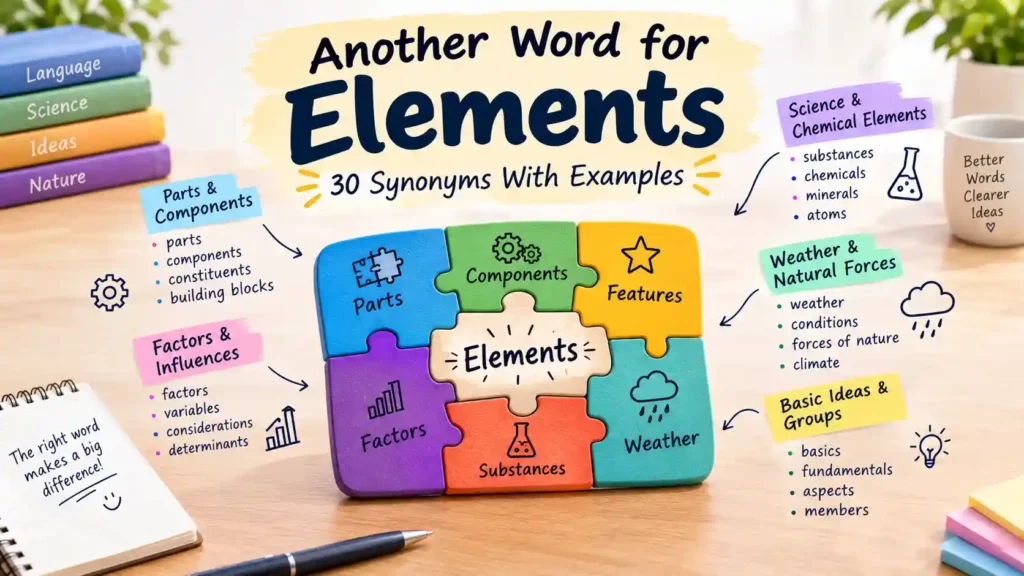
The closest everyday alternatives to “elements” are parts, components, and features when you mean the pieces that make up a whole. In science, substances and chemicals can stand in for chemical elements, and forces or conditions fit the weather sense. For a small amount of something, traces or hints work well.
The best alternative depends on meaning and context. “Elements” can mean basic parts of something, simple chemical substances, weather conditions, groups within a larger group, or the basic ideas of a subject. A word that suits a recipe, such as “ingredients,” will not work in a physics class, where “components” or “building blocks” is more natural.
Quick list: parts, components, ingredients, factors, features, constituents, building blocks, aspects, traces, basics
This article looks at 30 alternatives to “elements.” Each one has a meaning, IPA pronunciation, usage note, and example sentence, grouped by the sense it fits best.
At a Glance: Elements Synonyms and Related Alternatives
| Alternative | Part of Speech | Meaning | Register / Tone | Ideal Context |
| Parts | Noun | Pieces that make up a whole | Neutral, simple | Everyday use |
| Components | Noun | Parts of a machine, system, or plan | Neutral to formal | Engineering, technology |
| Ingredients | Noun | Foods or substances in a mixture | Neutral | Cooking, products |
| Factors | Noun | Things that influence a result | Neutral to formal | Analysis, decisions |
| Features | Noun | Noticeable parts or qualities | Neutral | Design, products |
| Constituents | Noun | Parts that make up a whole | Formal | Science, law |
| Building blocks | Noun phrase | Basic parts used to build something | Neutral | Learning, systems |
| Aspects | Noun | Particular sides of a subject | Neutral to formal | Discussion, writing |
| Traces | Noun | Very small amounts | Neutral | Chemistry, evidence |
| Basics | Noun | The simplest, most important ideas | Neutral, informal | Teaching, skills |
Which Word Should You Use?
| If you want to… | Use | Why |
| Name the pieces of a machine or system | Components, parts | Both suggest pieces that work together |
| Name items in a recipe or product | Ingredients | It is the usual word for mixtures |
| Name things that influence a result | Factors | It suggests causes or conditions |
| Name the simple ideas of a subject | Basics, fundamentals | Both stress the starting point |
| Name the weather conditions | Weather, conditions | They are natural in everyday speech |
| Name a small amount of something | Traces, hints | Both suggest a very little |
| Name the groups within a larger group | Members, factions | They suit people and organizations |
| Write about the parts of a story or design | Features, aspects | Both fit description and analysis |
Exploring the Multiple Meanings of “Elements”
1. Basic Parts of Something
- Meaning: The necessary or basic parts of a whole.
- Explanation: This is the most general sense. It covers the pieces that make up a plan, system, story, or design.
- Example: Trust is one of the key elements of a good team.
2. Chemical Elements
- Meaning: Pure substances made of one kind of atom, such as oxygen or iron.
- Explanation: This is the scientific sense. Each element has its own place on the periodic table and cannot be split into simpler substances by ordinary chemical means.
- Example: Gold and silver are elements.
3. Weather and Natural Forces
- Meaning: The weather conditions, especially wind, rain, and cold.
- Explanation: This sense is almost always used with “the,” as in “the elements.” It describes the power of nature as a challenge to people.
- Example: The hikers were not ready for the elements.
4. The Basic Ideas of a Subject
- Meaning: The first and simplest principles of a subject of study.
- Explanation: This sense is common in older book titles and teaching. It means the starting ideas a learner needs.
- Example: The course covers the elements of music.
5. Groups Within a Larger Group
- Meaning: A section or group of people within a larger group.
- Explanation: This sense often appears in news and politics. It can sound critical when it describes troublemakers.
- Example: Some elements in the crowd began to shout.
6. A Small Amount
- Meaning: A small amount of a quality or feeling.
- Explanation: This sense is usually written as “an element of.” It points to a small but real part of something.
- Example: There is an element of truth in his story.
Sources: Merriam-Webster; Collins English Dictionary; Dictionary.com.
Analyzing 30 Elements Alternatives in Detail
Some of these words are direct synonyms of “elements,” while others fit only one sense, so each usage note says which is which.
Core Alternatives: Parts of a Whole
1. Parts
IPA: /pɑːrts/ US · /pɑːts/ UK
Definition: Pieces that together make up a whole.
- Usage: A direct synonym for the “basic parts” sense. It is the simplest and most common choice.
- Example: The parts of the engine are sold separately.
2. Components
IPA: /kəmˈpoʊnənts/ US · /kəmˈpəʊnənts/ UK
Definition: Parts of a larger machine, system, or whole.
- Usage: A direct synonym for the “basic parts” sense. It is more formal than “parts” and common in technical writing.
- Example: The phone has many small electronic components.
3. Constituents
IPA: /kənˈstɪtʃuənts/ (US and UK)
Definition: Parts that make up a whole.
- Usage: A formal synonym used in science, law, and grammar. It sounds more technical than “parts.”
- Example: Water’s constituents are hydrogen and oxygen.
4. Ingredients
IPA: /ɪnˈɡriːdiənts/ (US and UK)
Definition: The foods or substances that are mixed to make something.
- Usage: A related alternative. It fits recipes, products, and figurative mixtures, such as “ingredients for success.”
- Example: Patience and hard work are the ingredients of success.
5. Building blocks
IPA: US /ˈbɪldɪŋ blɑːks/ · UK /ˈbɪldɪŋ blɒks/
Definition: The basic units from which something larger is made.
- Usage: A related alternative. It suggests simple pieces used to build something bigger and is common in teaching.
- Example: Letters are the building blocks of words.
6. Pieces
IPA: /ˈpiːsɪz/ (US and UK)
Definition: Separate parts or sections of something.
- Usage: A related alternative. It is informal and suggests parts that can be separated.
- Example: The story is told in several pieces.
Features and Aspects
7. Features
IPA: US /ˈfiːtʃərz/ · UK /ˈfiːtʃəz/
Definition: Noticeable or important parts or qualities.
- Usage: A related alternative. It fits products, designs, and places where parts can be seen.
- Example: The house has several modern features.
8. Aspects
IPA: /ˈæspɛkts/ (US and UK)
Definition: Particular sides or parts of a subject.
- Usage: A related alternative. It describes ways of looking at something, not physical parts.
- Example: The report covers all aspects of safety.
9. Facets
IPA: /ˈfæsɪts/ (US and UK)
Definition: Different sides or parts of a complex subject.
- Usage: A related, slightly literary alternative. It suggests a many-sided subject.
- Example: Teaching has many facets.
10. Characteristics
IPA: /ˌkærɪktəˈrɪstɪks/ (US and UK)
Definition: Typical qualities of a person or thing.
- Usage: A related alternative. It points to qualities that make something what it is, not to separate parts.
- Example: The main characteristics of the plan are low cost and speed.
11. Attributes
IPA: /ˈætrɪbjuːts/ (US and UK)
Definition: Qualities or features that belong to someone or something.
- Usage: A formal, related alternative. It describes qualities rather than physical parts.
- Example: Honesty is one of her best attributes.
Factors and Influences
12. Factors
IPA: US /ˈfæktərz/ · UK /ˈfæktəz/
Definition: Things that help cause a result.
- Usage: A related alternative for the “basic parts” sense when parts influence an outcome. It is neutral to formal.
- Example: Several factors affect the price of a house.
13. Variables
IPA: /ˈvɛriəbəlz/ US · /ˈveəriəbəlz/ UK
Definition: Things that can change and affect a result.
- Usage: A related technical alternative. It fits science, math, and planning.
- Example: The experiment controlled several variables.
14. Considerations
IPA: /kənˌsɪdəˈreɪʃənz/ (US and UK)
Definition: Things to think about before deciding.
- Usage: A related alternative. It suits decisions and plans, not physical parts.
- Example: Cost is one of the main considerations.
15. Determinants
IPA: /dɪˈtɜːrmɪnənts/ US · /dɪˈtɜːmɪnənts/ UK
Definition: Factors that decide or control a result.
- Usage: A formal, related alternative. It is common in research and social science.
- Example: Income is a major determinant of health.
Chemical and Scientific Alternatives
16. Substances
IPA: /ˈsʌbstənsɪz/ (US and UK)
Definition: Kinds of matter with particular qualities.
- Usage: A related alternative for the chemical sense. It is wider than “elements,” since many substances are mixtures or compounds.
- Example: Some substances burn easily.
17. Chemicals
IPA: /ˈkɛmɪkəlz/ (US and UK)
Definition: Substances made by or used in chemistry.
- Usage: A related alternative. It is everyday language and does not mean “pure elements.”
- Example: The factory stores several dangerous chemicals.
18. Minerals
IPA: /ˈmɪnərəlz/ (US and UK)
Definition: Natural substances found in the earth, or needed by the body.
- Usage: A related alternative. Some elements occur as minerals, but the two words are not the same.
- Example: Calcium and iron are important minerals for health.
19. Atoms
IPA: /ˈætəmz/ (US and UK)
Definition: The smallest units of a chemical element.
- Usage: A related alternative. An atom is one unit of an element, not the element itself.
- Example: Water is made of hydrogen and oxygen atoms.
Weather and Natural Forces
20. Weather
IPA: US /ˈwɛðər/ · UK /ˈwɛðə/
Definition: The condition of the air, such as rain, wind, and temperature.
- Usage: A related alternative for “the elements.” It is simple and natural in speech.
- Example: The weather forced us to turn back.
21. Forces of nature
IPA: US /ˈfɔːrsɪz əv ˈneɪtʃər/ · UK /ˈfɔːsɪz əv ˈneɪtʃə/
Definition: Powerful natural events such as storms and floods.
- Usage: A related alternative. It suggests strong, often dangerous natural power.
- Example: The village was destroyed by forces of nature.
22. Conditions
IPA: /kənˈdɪʃənz/ (US and UK)
Definition: The state of the weather or surroundings.
- Usage: A related alternative. It is neutral and common in reports about weather and roads.
- Example: Driving conditions were poor.
Basic Ideas of a Subject
23. Basics
IPA: /ˈbeɪsɪks/ (US and UK)
Definition: The simplest and most important parts of a subject.
- Usage: A direct synonym for the “basic ideas” sense. It is neutral and slightly informal.
- Example: She taught us the basics of cooking.
24. Fundamentals
IPA: /ˌfʌndəˈmɛntəlz/ (US and UK)
Definition: The central and most important principles of something.
- Usage: A close synonym for the “basic ideas” sense. It is more formal than “basics.”
- Example: The class covers the fundamentals of algebra.
25. Principles
IPA: /ˈprɪnsəpəlz/ (US and UK)
Definition: Basic rules or ideas that explain how something works.
- Usage: A related alternative. It points to rules, not parts.
- Example: The book explains the principles of design.
26. Essentials
IPA: /ɪˈsɛnʃəlz/ (US and UK)
Definition: The most necessary parts or items.
- Usage: A related alternative. It stresses what is absolutely needed.
- Example: Pack only the essentials for the trip.
Groups and Small Amounts
27. Factions
IPA: /ˈfækʃənz/ (US and UK)
Definition: Small organized groups within a larger group.
- Usage: A related alternative for the “groups within a group” sense. It often suggests conflict.
- Example: Two factions in the party disagreed.
28. Members
IPA: US /ˈmɛmbərz/ · UK /ˈmɛmbəz/
Definition: People who belong to a group.
- Usage: A related alternative, and a neutral one. It does not suggest trouble the way “elements” sometimes does.
- Example: Some members of the crowd were angry.
29. Traces
IPA: /ˈtreɪsɪz/ (US and UK)
Definition: Very small amounts of something.
- Usage: A related alternative for the “small amount” sense. It suggests a barely noticeable amount.
- Example: The test found traces of lead in the water.
30. Hints
IPA: /hɪnts/ (US and UK)
Definition: Small signs or slight amounts of a quality.
- Usage: A related alternative for the “small amount” sense. It is softer and works for feelings and flavors.
- Example: The speech had hints of humor.
Sources: Merriam-Webster; Collins English Dictionary and Collins Thesaurus; Dictionary.com; Oxford Learner’s Dictionaries (pronunciation).
Elements vs. Components vs. Factors vs. Features
| Word | Main Idea | Typical Setting | Example |
| Elements | Basic parts of a whole | General, science, weather | The story has four key elements. |
| Components | Parts of a system or machine | Technology, engineering | The radio has three main components. |
| Factors | Things that influence a result | Analysis, decisions | Weather was a factor in the delay. |
| Features | Noticeable parts or qualities | Products, places | The car has new safety features. |
“Elements” is the widest term. “Components” fits systems, “factors” fits causes, and “features” fits what people can notice.
Sources: Merriam-Webster; Collins English Dictionary.
Elements and Opposite/Paired Word Pairs
| Word | Paired Word | Note |
| Elements | Whole | The parts and the thing they form |
| Elements | Compounds | In chemistry, pure substances versus joined ones |
| Elements | Mixtures | Pure substances versus substances mixed together |
| Elements | Totality | A formal contrast with all the parts together |
| The elements | Shelter | Weather and protection from it |
“Elements” has no single opposite. Its natural pairs are the whole it belongs to, and in chemistry, compounds and mixtures.
Sources: Merriam-Webster; Collins English Dictionary and Collins Thesaurus.
Common Word Partners of “Elements”
| Pattern | Common Partners | Example |
| adjective + elements | key, basic, essential, main, important | Honesty is one of the key elements. |
| elements of + noun | elements of style, elements of surprise | The film has elements of comedy. |
| chemical + elements | chemical elements, rare elements | Iron is one of the chemical elements. |
| the elements | brave the elements, exposed to the elements | The tents protect us from the elements. |
| criminal / disruptive + elements | criminal elements, extremist elements | Criminal elements were blamed for the damage. |
| elements + verb | combine, make up, form | Several elements make up the plan. |
Sources: Collins English Dictionary; Oxford Collocations Dictionary; Merriam-Webster.
Idiomatic Phrases Featuring “Elements”
1. In one’s element
- Meaning: In a situation where you feel comfortable and do well.
- Example: She is in her element when she teaches.
2. Out of one’s element
- Meaning: In a situation that feels strange or uncomfortable.
- Example: He felt out of his element at the formal dinner.
3. Brave the elements
- Meaning: To go out in bad weather in spite of the difficulty.
- Example: Fans braved the elements to watch the match.
4. Element of surprise
- Meaning: An advantage gained by doing something unexpected.
- Example: The team won with the element of surprise.
Sources: Merriam-Webster; Collins English Dictionary; Cambridge Dictionary.
Word Formation of “Elements”
Etymology & Structure
“Element” comes from Latin elementum, which meant a basic part or first principle. It came into English through Old French. “Elements” is the plural form, made by adding “-s.” Dictionaries do not agree on the deeper origin of the Latin word, so it is best treated as uncertain.
Date and History
The word has been in English since the Middle Ages. For the exact earliest year, check Etymonline or the Oxford English Dictionary, since dates vary by sense.
Word Class Variations
- Noun: element, elements
- Adjective: elemental, elementary
- Adverb: elementally (rare)
- Related forms: elementary (basic), elemental (basic or natural)
Sources: Etymonline; Merriam-Webster; Collins English Dictionary.
Common Word-Choice Mistakes
- The elements of the cake are flour and eggs: the ingredients of the cake are flour and eggs. “Ingredients” is the natural word for food.
- Criminal members attacked the shop: criminal elements attacked the shop. Use “elements” for a loose group, not for formal members.
- An elementary school is made of elements: an elementary school teaches basic subjects. “Elementary” means basic.
- The element of the chemical: the element in the compound. “Element” means a pure substance, not a chemical product.
- Elemental and elementary mean the same: “elemental” means basic or natural, while “elementary” means simple or for beginners.
- Elements affect the decision: factors affect the decision. “Factors” is more natural for influences.
- They braved the element: they braved the elements. The weather sense is plural.
Frequently Asked Questions
What is the closest synonym for elements?
“Parts” and “components” are the closest for the general sense. For basic ideas, “basics” and “fundamentals” fit.
What is another word for elements of a story?
“Components,” “features,” and “aspects” all work, depending on the focus.
What is another word for key elements?
“Key components,” “main factors,” and “essential parts” are natural choices.
What is another word for elements in science?
“Substances” is a related word, but it is wider. “Chemical elements” is the exact term and has no true synonym.
What is another word for the elements in weather?
“Weather,” “conditions,” and “forces of nature” are common.
What is the difference between elements and components?
“Elements” is a general word for basic parts. “Components” usually describes parts of a system or machine.
What is the difference between elements and factors?
“Elements” are parts of something, while “factors” are things that influence a result.
What is a formal alternative to elements?
“Constituents” and “components” are formal. “Determinants” is formal for the factor sense.
Can elements be used for people?
Yes, but mostly for groups, as in “disruptive elements.” It can sound critical.
What is the opposite of elements?
There is no single opposite. “Whole” is the natural contrast, and “compound” contrasts in chemistry.
Conclusion
The closest everyday alternatives to “elements” are “parts,” “components,” and “features.” For influences, “factors” works well, and for basic ideas, “basics” and “fundamentals” are common.
Context decides which word works. Some alternatives name physical pieces, some name causes, some name chemical substances, and some name weather, so a good synonym in one sentence can be wrong in another.
To choose well, first decide which meaning of “elements” you want. Then pick the word that matches that meaning and the tone of your writing, formal or casual.

Emily Johnson is a linguistics graduate and vocabulary specialist. She writes detailed synonym explanations and helps readers understand subtle differences between words, improving both writing and speaking skills. Synonyms help express ideas more clearly and precisely in English.