
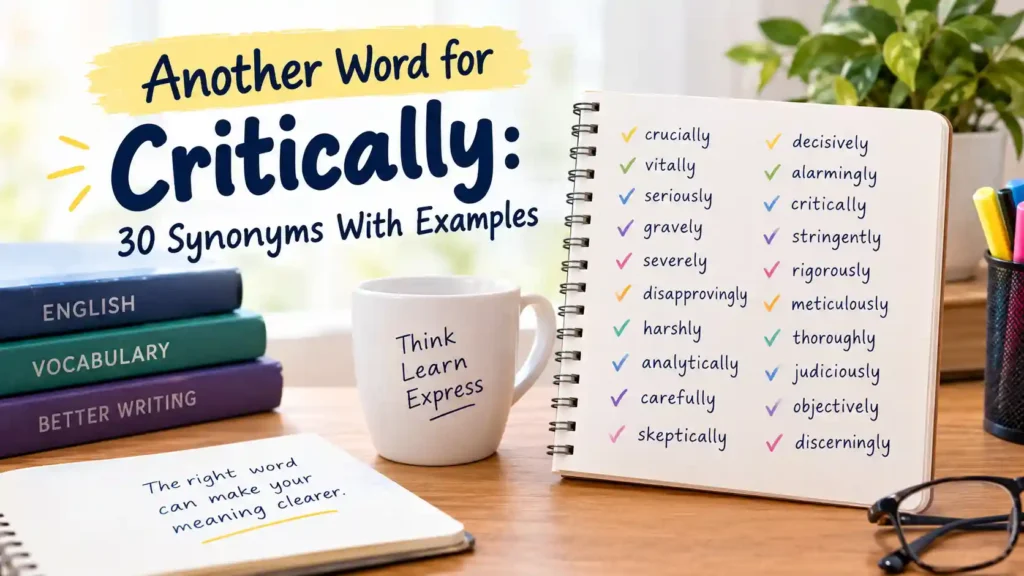
Another word for critically depends on how you use itWhen you mean “very importantly,” try crucially or vitally. For the meaning “seriously ill or injured,” use seriously, gravely, or severely. If you want to express disapproval, disapprovingly or harshly may fit better. When you mean “with careful thought,” consider analytically or carefully.
Critically is an adverb with several different meanings. It can describe disapproval, careful judgment, danger, great importance, or the opinion of critics. Because of this, no single synonym works everywhere, and the right word depends on the meaning you want.
Quick list: crucially, vitally, seriously, gravely, severely, disapprovingly, harshly, analytically, carefully, skeptically
This article examines 30 alternatives. Each one includes a meaning, IPA pronunciation, usage note, and example sentence, grouped by the sense of “critically” it matches best.
At a Glance: Critically Synonyms and Related Alternatives
| Alternative | Part of Speech | Meaning | Register / Tone | Ideal Context |
| Crucially | Adverb | In a way that decides the outcome | Neutral to formal | Explaining what matters most |
| Vitally | Adverb | In an essential way | Neutral to formal | “Vitally important,” “vitally needed” |
| Seriously | Adverb | In a way that is grave or severe | Neutral | Illness, injury, damage |
| Gravely | Adverb | In a very serious, worrying way | Formal | Illness, danger, concern |
| Severely | Adverb | To a very great or harsh degree | Neutral to formal | Injury, damage, shortage |
| Dangerously | Adverb | In a way that risks harm | Neutral | Levels that could cause harm |
| Disapprovingly | Adverb | In a way that shows disapproval | Neutral | Looks, comments, reactions |
| Harshly | Adverb | In a severe, unkind way | Neutral | Strong judgment or blame |
| Analytically | Adverb | By breaking something into parts and studying it | Formal | Study, research, evaluation |
| Carefully | Adverb | With close attention | Everyday, neutral | Reading, checking, thinking |
Which Word Should You Use?
| If you want to… | Use | Why |
| Say something is extremely important | crucially or vitally | Both focus on importance, without the other senses of “critically.” |
| Describe someone in a life-threatening condition | gravely or severely | They are clear and formal for health and injury. |
| Express a negative opinion | disapprovingly or harshly | They remove any doubt about the negative tone. |
| Describe careful study of an idea | analytically | It points to breaking an idea into parts. |
| Describe a level that has become unsafe | dangerously or alarmingly | They suit levels that are too low or too high. |
| Say someone questions what they read | skeptically | It shows doubt rather than disapproval. |
| Say something decides the result | decisively or crucially | Both stress the effect on the outcome. |
| Say reviewers praised a work | “praised by critics” or “widely acclaimed” | “Critically acclaimed” has no exact one-word replacement. |
Exploring the Multiple Meanings of “Critically”
1. In a Disapproving Way
- Meaning: In a way that shows disapproval or points out faults.
- Explanation: This sense is about opinion. The speaker is judging something as bad or wrong. It is often followed by “of,” as in “speak critically of someone.”
- Example: She spoke critically of the new policy.
2. With Careful Judgment
- Meaning: In a way that involves careful, fair analysis of good and bad points.
- Explanation: This sense is not negative. It means thinking about something closely before accepting it. It is common in education, as in “think critically.”
- Example: Students learn to read news stories critically.
3. In a Serious or Dangerous Condition
- Meaning: To a serious, extreme, or dangerous degree.
- Explanation: This sense is common with illness and injury, where it points to danger of death. It is also used for levels or supplies that have reached a dangerous point.
- Example: The driver was critically injured in the crash.
4. In an Extremely Important Way
- Meaning: In a way that is essential to the outcome.
- Explanation: This sense is often used with “important.” It stresses that a result depends on something. It can also begin a sentence to highlight the key point.
- Example: It is critically important to save your work often.
5. According to Critics
- Meaning: In a way connected with the judgment of critics of art, music, books, or film.
- Explanation: This sense appears in set phrases such as “critically acclaimed.” It describes how critics, not the general public, judged a work.
- Example: The film was critically acclaimed but did not sell many tickets.
Sources: Oxford Advanced Learner’s Dictionary; Dictionary.com; Merriam-Webster
Analyzing 30 Critically Alternatives in Detail
Some alternatives below match one sense of “critically” closely, while others are related words that fit only certain contexts. Each Usage note says which is which.
Importance and Decisive Effect
1. Crucially
IPA: (US and UK) /ˈkruːʃəli/
Definition: In a way that is of decisive importance to the outcome.
- Usage: A direct synonym for the “extremely important” sense. It can also begin a sentence to highlight the key point. It does not fit the health or disapproval senses.
- Example: Crucially, the team agreed on a plan before the deadline.
2. Vitally
IPA: (US and UK) /ˈvaɪtəli/
Definition: In a way that is absolutely necessary.
- Usage: A direct synonym for the “important” sense, most often paired with “important” or “needed.” It sounds neutral to formal.
- Example: Clean water is vitally important for health.
3. Importantly
IPA: US /ɪmˈpɔːrtntli/ · UK /ɪmˈpɔːtntli/
Definition: In a way that matters a great deal.
- Usage: A milder alternative to “critically.” It works well at the start of a sentence, as in “more importantly,” but it is less strong than crucially or vitally.
- Example: The medicine was cheap and, importantly, it worked.
4. Fundamentally
IPA: (US and UK) /ˌfʌndəˈmentəli/
Definition: In a basic or essential way.
- Usage: A related alternative for the “important” sense. It stresses that something is basic to a larger idea, not that it decides an outcome.
- Example: The two plans are fundamentally different.
5. Decisively
IPA: (US and UK) /dɪˈsaɪsɪvli/
Definition: In a way that settles a question or result.
- Usage: A related alternative. It describes actions or events that settle a result, so it does not work for “critically important.”
- Example: The final goal decisively changed the match.
Serious Condition
6. Seriously
IPA: US /ˈsɪriəsli/ · UK /ˈsɪəriəsli/
Definition: In a way that is severe or causes real concern.
- Usage: A direct synonym for the health sense, as in “seriously ill.” It is slightly less extreme than “critically,” which suggests danger of death.
- Example: He was seriously hurt in the fall.
7. Severely
IPA: US /sɪˈvɪrli/ · UK /sɪˈvɪəli/
Definition: To a very great or harsh degree.
- Usage: A direct synonym for injury, damage, or shortage. It sounds neutral to formal.
- Example: The storm severely damaged the roof.
8. Gravely
IPA: (US and UK) /ˈɡreɪvli/
Definition: In a very serious and worrying way.
- Usage: A formal synonym of the health sense, as in “gravely ill.” It can also mean “in a solemn manner,” so check the context.
- Example: The patient was gravely ill when he arrived.
9. Acutely
IPA: (US and UK) /əˈkjuːtli/
Definition: To a sharp or intense degree.
- Usage: A related alternative. It fits “acutely aware” or “acutely ill,” but it does not carry the “danger of death” meaning as strongly.
- Example: She was acutely aware of the risks.
10. Badly
IPA: (US and UK) /ˈbædli/
Definition: To a serious or severe degree; in a poor way.
- Usage: An informal, related alternative, as in “badly injured.” It is less formal and less precise than seriously or gravely.
- Example: Two workers were badly burned in the fire.
Disapproval
11. Disapprovingly
IPA: (US and UK) /ˌdɪsəˈpruːvɪŋli/
Definition: In a way that shows a negative opinion.
- Usage: A direct synonym for the “disapproving” sense. It is often used for looks and tone of voice.
- Example: The teacher looked at the messy desk disapprovingly.
12. Unfavorably
IPA: (US and UK) /ʌnˈfeɪvərəbli/
Definition: In a negative or unhelpful way.
- Usage: A direct but more formal synonym. It is often used with “compare” and “review.” The usual UK spelling is “unfavourably.”
- Example: The reviewer compared the sequel unfavorably to the first film.
13. Harshly
IPA: US /ˈhɑːrʃli/ · UK /ˈhɑːʃli/
Definition: In a severe or unkind way.
- Usage: A stronger alternative to “critically.” It suggests the judgment was too strong or unkind.
- Example: The coach spoke harshly of the team’s effort.
14. Disparagingly
IPA: (US and UK) /dɪˈspærɪdʒɪŋli/
Definition: In a way that suggests something has little value.
- Usage: A related alternative. It is stronger than “critically” because it shows contempt, not only disapproval.
- Example: He spoke disparagingly of his rivals.
15. Censoriously
IPA: (US and UK) /senˈsɔːriəsli/
Definition: In a way that is very quick to condemn or blame.
- Usage: A formal, rare alternative. It fits a strict, fault-finding manner, and it sounds literary.
- Example: The neighbor glanced censoriously at the noisy children.
Careful Analysis
16. Analytically
IPA: (US and UK) /ˌænəˈlɪtɪkli/
Definition: In a way that studies something by breaking it into parts.
- Usage: A close synonym for the “careful judgment” sense. It sounds formal and is common in study and research.
- Example: She looked at the data analytically before she made her decision.
17. Carefully
IPA: US /ˈkerfəli/ · UK /ˈkeəfəli/
Definition: With close attention and effort.
- Usage: The simplest everyday alternative for the “careful judgment” sense. It does not carry the idea of judging good and bad points.
- Example: Read the contract carefully before you sign it.
18. Discerningly
IPA: US /dɪˈsɜːrnɪŋli/ · UK /dɪˈsɜːnɪŋli/
Definition: In a way that shows good judgment or taste.
- Usage: A formal, related alternative. It stresses skill at telling good from bad, not just careful study.
- Example: The editor read the manuscript discerningly.
19. Rigorously
IPA: (US and UK) /ˈrɪɡərəsli/
Definition: In a thorough and strict way.
- Usage: A related alternative. It fits testing, checking, and research, where the method is strict.
- Example: The claims were rigorously tested before publication.
20. Judiciously
IPA: (US and UK) /dʒuˈdɪʃəsli/
Definition: With good judgment and sense.
- Usage: A formal, related alternative. It describes wise choices, not the act of analysing something.
- Example: She spent her budget judiciously.
Extreme Degree and Urgency
21. Extremely
IPA: (US and UK) /ɪkˈstriːmli/
Definition: To a very great degree.
- Usage: A simple, general alternative for “critically low,” “critically important,” and similar uses. It does not suggest danger on its own.
- Example: The test results were extremely important.
22. Urgently
IPA: US /ˈɜːrdʒəntli/ · UK /ˈɜːdʒəntli/
Definition: In a way that needs immediate action.
- Usage: A related alternative for the “important” sense when time is short, as in “urgently needed.”
- Example: The hospital urgently needs more blood donors.
23. Desperately
IPA: (US and UK) /ˈdespərətli/
Definition: In a way that shows great need or loss of hope.
- Usage: A related alternative that adds emotion. It fits “desperately needed” or “desperately ill,” but it is less formal than critically.
- Example: The village desperately needs clean water.
24. Dangerously
IPA: (US and UK) /ˈdeɪndʒərəsli/
Definition: In a way that could cause harm.
- Usage: A close synonym for levels that have reached a risky point, such as “dangerously low.” It fits the “dangerous degree” part of the serious-condition sense.
- Example: The river was dangerously high after the storm.
25. Alarmingly
IPA: US /əˈlɑːrmɪŋli/ · UK /əˈlɑːmɪŋli/
Definition: In a way that causes worry or fear.
- Usage: A related alternative for numbers and levels that cause concern, such as “alarmingly high.”
- Example: Food supplies were alarmingly low.
Questioning and Thoughtful Evaluation
26. Skeptically
IPA: (US and UK) /ˈskeptɪkli/
Definition: With doubt about whether something is true.
- Usage: A related alternative for the “careful judgment” sense. It shows doubt, so it is narrower than critically. The UK spelling is “sceptically.”
- Example: He read the advertisement skeptically.
27. Objectively
IPA: (US and UK) /əbˈdʒektɪvli/
Definition: Without letting personal feelings change the judgment.
- Usage: A related alternative. It stresses fairness instead of analysis, so it works when someone must avoid bias.
- Example: It is hard to judge your own work objectively.
28. Thoughtfully
IPA: (US and UK) /ˈθɔːtfəli/
Definition: In a way that shows careful thinking.
- Usage: A gentle, related alternative. It is warmer and less formal than “analytically,” and it does not involve judging faults.
- Example: She answered the question thoughtfully.
29. Closely
IPA: US /ˈkloʊsli/ · UK /ˈkləʊsli/
Definition: With careful attention to details.
- Usage: A related alternative, as in “examine closely.” It describes how carefully someone looks, not what they decide.
- Example: The doctor examined the scan closely.
30. Reflectively
IPA: (US and UK) /rɪˈflektɪvli/
Definition: In a way that shows deep, quiet thinking.
- Usage: A related, formal alternative. It points to looking back and thinking things through, so it is the weakest match for “critically.”
- Example: He wrote reflectively about his first year at university.
Sources: Merriam-Webster; Dictionary.com; Oxford Advanced Learner’s Dictionary
Critically vs. Crucially vs. Seriously
These three words overlap, but each has its own range. This table shows where they are interchangeable and where they are not.
| Word | Main Meanings | Works With | Note |
| Critically | Disapproving, analytical, dangerous, very important, by critics | ill, injured, important, low, think, acclaimed | Has the widest range, so it can be unclear. |
| Crucially | Decisive for the outcome | important, needed, relies on | Never means “with disapproval” or “in a critical state of health.” |
| Seriously | In a severe way; in a sincere way | ill, injured, damaged | Also means “honestly,” so it is less exact in some contexts. |
The word “critically” can also be unclear on its own. In “She looked critically at the plan,” the reader may not know whether she found faults or studied it carefully. Choosing disapprovingly or analytically removes that doubt.
Sources: Oxford Advanced Learner’s Dictionary; Dictionary.com; Merriam-Webster
Critically and Opposite/Paired Word Pairs
| Word | Paired Word | Note |
| Critically | Uncritically | The most direct opposite for the “careful judgment” sense. |
| Critically (disapproving) | Approvingly / favorably | Contrasts a negative opinion with a positive one. |
| Critically ill | Mildly ill | Contrasts danger of death with a small problem. |
| Critically important | Unimportant | Contrasts great importance with little or none. |
| Critically acclaimed | Critically panned | Contrasts praise from critics with harsh reviews. |
“Critically” has no single opposite, because each sense has its own contrast. “Uncritically” is listed as the antonym in Vocabulary.com, and it means accepting something without questioning it. For the other senses, a natural opposite depends on the meaning, such as “approvingly” for disapproval or “mildly” for a serious health condition.
Sources: Vocabulary.com; Etymonline; Oxford Advanced Learner’s Dictionary
Common Word Partners of “Critically”
| Pattern | Common Partners | Example |
| critically + adjective (importance) | important, needed | Clear communication is critically important. |
| critically + adjective (level) | low, high, short | Water levels are critically low. |
| verb + critically | think, look, examine, evaluate | You should examine every claim critically. |
| speak / write + critically of | speak, write | She wrote critically of the report. |
| critically + verb | lacking, relies on | The plan critically relies on good weather. |
Sources: Dictionary.com; Merriam-Webster; Oxford Advanced Learner’s Dictionary
Idiomatic Phrases Featuring “Critically”
“Critically” has no true idioms. The items below are established fixed expressions in which the word has a set meaning.
1. Critically acclaimed
- Meaning: Praised by reviewers or critics, especially for a film, book, or album.
- Example: The critically acclaimed novel won a major prize.
2. Critically ill
- Meaning: Very sick, with a danger of death. Because “critically” ends in -ly, it is not joined to “ill” with a hyphen.
- Example: The patient is critically ill and in intensive care.
3. Critically endangered
- Meaning: At very high risk of dying out. It is used for animals and plants in conservation.
- Example: The black rhino is critically endangered.
4. Think critically
- Meaning: Judge ideas carefully instead of accepting them at once.
- Example: Good teachers help students think critically about what they read.
Sources: Merriam-Webster; Dictionary.com; Oxford Advanced Learner’s Dictionary
Word Formation of “Critically”
Etymology & Structure
“Critically” is built from the adjective critical plus the adverb ending -ly. Critical comes from critic plus -al. Critic came into English from French critique, from Latin criticus (“a judge, a censor”), from Greek kritikos (“able to make judgments”). The Greek word comes from krinein (“to separate, decide”).
Date and History
Etymonline dates “critical” to the 1580s, with the meaning “inclined to find fault.” Merriam-Webster gives 1556 as the first known use of “critical,” so the dates differ slightly between sources. For “critically,” Etymonline records the sense “accurately” in the 1650s and “in a critical situation” in 1815. The “important to the outcome” sense of “critical” appears from about 1600, and the “crisis” sense from the 1660s.
Word Class Variations
- Adjective: critical
- Adverb: critically
- Noun: criticalness, criticality
- Related words: critic (noun), criticism (noun), criticize (verb), critique (noun and verb)
- Negative forms: uncritical, uncritically, noncritically
- Intensified form: hypercritical, hypercritically
Sources: Etymonline; Merriam-Webster; Dictionary.com
Common Word-Choice Mistakes
- She is critically sick with a cold: use “she has a bad cold.” “Critically” suggests danger of death.
- A critically nice idea: use “a really nice idea.” “Critically” fits importance and danger, not simple praise.
- He thinks critical about the news: use “he thinks critically about the news.” An adverb is needed after the verb.
- The restaurant was critically acclaimed by customers: use “widely praised by customers.” “Critically acclaimed” refers to critics.
- A critically-ill patient: write “a critically ill patient.” Adverbs ending in -ly are not hyphenated.
- The coach criticized the team critically: use “criticized the team harshly.” The word “critically” repeats “criticized.”
- Criticaly important: spell it “critically important.” The word keeps the double “l” from “critical” plus “-ly.”
Frequently Asked Questions
What is the closest synonym for critically?
It depends on the meaning. Use crucially or vitally for importance, gravely or seriously for health, disapprovingly for negative opinion, and analytically for careful thought.
What is the difference between critically and crucially?
Crucially means “in a way that decides the outcome.” Critically has that meaning too, but it also covers disapproval, careful analysis, and danger.
Does critically always mean something negative?
No. It can mean “with disapproval,” but it can also mean “with careful judgment” or “very importantly.” The context shows which sense is meant.
What is a formal alternative for “critically ill”?
“Gravely ill” and “seriously ill” are good choices. “Gravely” sounds more formal.
What is another way to say “critically important”?
You can say crucially important, vitally important, fundamentally important, or extremely important. “Vitally” and “crucially” are the closest.
What does “critically acclaimed” mean?
It means praised by critics, such as film or book reviewers. It does not mean the public liked the work.
What is another way to say “think critically”?
“Think analytically,” “think carefully,” or “think skeptically” can work. “Analytically” is the closest for study and research.
What is the opposite of critically?
“Uncritically” is the closest opposite for the careful-judgment sense. For other senses, the opposite changes, such as “approvingly” for disapproval.
Can critically begin a sentence?
Yes. It can work as a sentence adverb meaning “most importantly,” as in “Critically, the test failed.” You can use “crucially” or “importantly” to say the same thing.
Where does critically come from?
It comes from “critical” plus “-ly.” “Critical” comes from “critic,” which traces back to the Greek word kritikos, meaning “able to judge.”
Conclusion
The closest alternatives to critically are crucially and vitally for importance, gravely and seriously for health, disapprovingly and harshly for negative judgment, and analytically and carefully for thoughtful study.
Context matters because “critically” has more than one meaning. A word that fits “critically ill” will not fit “critically acclaimed,” and a word for disapproval will not fit “think critically.” Related words such as acutely or objectively fit only part of the range.
To choose the right word, first decide which meaning you want. Then pick the synonym that matches that meaning, and use “critically” itself when the sense is already clear from the phrase, as in “critically important” or “critically ill.”

Emily Johnson is a linguistics graduate and vocabulary specialist. She writes detailed synonym explanations and helps readers understand subtle differences between words, improving both writing and speaking skills. Synonyms help express ideas more clearly and precisely in English.